


HEMA-Free Gel Nail Polish Brands: What Changed, What to Buy, and Why It Matters
Most people who develop a gel polish allergy never see it coming. They've been using gel for two or three years, the same brand, the same application routine — and then one day the skin around their nails starts itching. Then it swells. Sometimes it spreads to their eyelids, their lips, the inside of their wrists — anywhere they've unconsciously touched wet, uncured gel. The culprit, in the majority of cases, is HEMA: hydroxyethyl methacrylate, a small monomer used as a building block in most conventional gel polish formulas.
HEMA sensitization is irreversible. Once the immune system identifies it as a threat, it reacts to every future exposure — including from other acrylate-containing products like dental bonding agents, medical adhesives, and contact lens solutions. This is not a rare edge case. European dermatologists flagged HEMA as one of the fastest-growing occupational allergens in nail technicians, and updated EU cosmetics regulations have pushed the professional nail industry to respond.
The response, in 2025–2026, has arrived. This guide covers the leading HEMA-free gel nail polish brands that have reformulated without HEMA — what they removed, what they replaced it with, whether the performance held, and which products from The Beauty Box's nail collection to start with.
What Is HEMA and Why Does It Cause Allergies?
HEMA (hydroxyethyl methacrylate) is a short-chain monomer — a reactive molecule that forms bonds during the polymerisation process when gel polish cures under UV or LED light. Its small molecular size is what makes it both useful and dangerous: HEMA penetrates the nail plate and surrounding skin more readily than larger monomers, allowing it to reach the dermis and trigger an immune response.
Sensitization happens cumulatively. Each exposure to uncured gel polish — particularly skin contact with uncured product — adds to the body's sensitization load. Most people tolerate multiple exposures before reacting. But once the threshold is crossed, even trace amounts of HEMA trigger a reaction. Patch testing, once sensitization occurs, typically shows cross-reactivity with the broader acrylate family — meaning a HEMA-allergic individual may also react to Di-HEMA TRIMETHYLHEXYL DICARBAMATE (Di-HEMA), HPMA, and other related monomers used in conventional gel formulas.
The three main routes of HEMA exposure in gel services are:
- Skin flooding: gel polish that runs onto the skin around the nail during application and is not removed before curing.
- Uncured layers: gel that does not reach full cure under the lamp — either from insufficient wattage, inadequate cure time, or shading from a curved nail surface — leaving reactive monomers against the skin.
- Removal contact: acetone-soaked removal pads placed on recently-exposed skin, allowing dissolved uncured product to penetrate.
The solution most brands have pursued is replacing HEMA and Di-HEMA with larger acrylate monomers that still polymerise effectively but have a molecular size too large to penetrate the skin barrier efficiently. The formulation challenge is maintaining gel performance — adhesion, coverage, shine, wear time — with those alternative monomers.
What "HEMA-Free" Actually Means on a Label
Not every "HEMA-free" claim covers the same scope. Reading the ingredients of any HEMA-free gel nail polish worth buying, you should verify that it is free of:
-
HEMA (hydroxyethyl methacrylate) — the primary sensitizer
-
Di-HEMA TRIMETHYLHEXYL DICARBAMATE — a cross-linker used in many gel formulas that carries the same sensitization risk
-
TPO (diphenyl(2,4,6-trimethylbenzoyl)phosphine oxide) — a photoinitiator linked to sensitization that some brands still include even in HEMA-free formulas
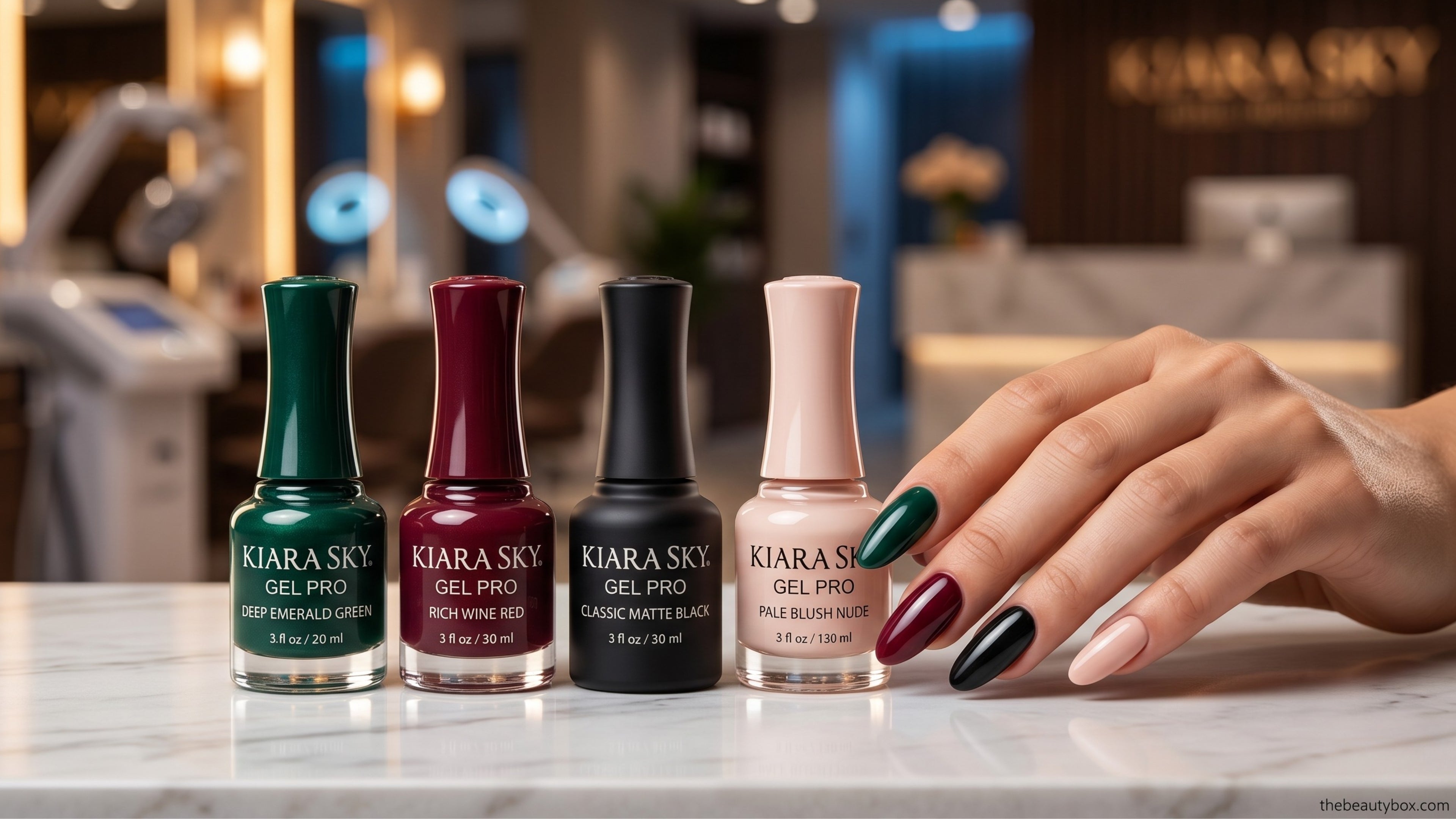
The most rigorous HEMA-free gel nail polish brands in 2026 remove all three. A gel polish that is HEMA-free but still contains Di-HEMA is still a sensitization risk. The Kiara Sky Gel Pro line — the most comprehensive HEMA-free option available at The Beauty Box — is formulated without HEMA, Di-HEMA, and TPO. That triple-free formulation is the current standard to hold other brands against.
Label check: if a gel polish says "HEMA-free" but the INCI list still contains "Di-HEMA TRIMETHYLHEXYL DICARBAMATE" or "Diphenyl(2,4,6-trimethylbenzoyl)phosphine oxide," it is not fully sensitization-safe. Always verify the full ingredient list, not just the marketing claim on the front of the bottle.
Kiara Sky Gel Pro: The Most Complete HEMA-Free System at The Beauty Box
Kiara Sky's Gel Pro line is the most fully-developed HEMA-free gel nail polish system available through The Beauty Box. It is not a single reformulated shade or a limited capsule collection — it is a sustained, expanding product line that now spans multiple seasonal collections, individual shade releases, and a parallel HEMA-free Builder Gel system for nail extensions.
Individual Shades
Every individual Kiara Sky Pro HEMA-Free Gel shade is HEMA-free, Di-HEMA-free, and TPO-free. Available individually at $16.99 per 0.5 fl oz bottle — a modest premium over the standard soak-off line. Shades available through the Kiara Sky HEMA-Free Gel Polish collection include:
- True Black — the essential neutral black that every professional colour menu needs
- Power Surge — a bold, saturated shade for the maximalist edge of the palette
- Soul-stice — a sophisticated mid-tone suited to year-round professional services
- Velvet Rouge — a deep, muted red that reads as editorial rather than primary
- Sweet Seduction — sits in the pink-nude crossover zone that dominates quiet luxury nail aesthetics
- Wine And Only — a reliable deep wine that transitions seamlessly from autumn through winter bookings
- Marooned — a moody, slightly muted burgundy
- Vamp It Up — dark and dramatic, suited to bold service menus
- Navy-gate Life — a classic navy that works across age groups and skin tones
- Tidal Babe — a fresh ocean-adjacent shade for spring and summer rotations
- Pine-ing For Me — forest green with enough depth to stay wearable outside seasonal windows
- Left On Red — a vivid, attention-commanding red
- In The Greentime — a lighter, more playful green for clients who want colour without drama
Seasonal Collections: 18-Shade Sets
For professionals building a full HEMA-free service menu, the 18-shade collection sets represent the fastest way to establish comprehensive coverage. Three collections are currently available through The Beauty Box:
- The Autumn Essence: 18 HEMA-free shades calibrated for the warm, earthy autumn palette — amber tones, deep greens, burnt siennas, and dusty mauves
- The Timeless Tints: 18 shades covering the neutral staples that hold across every season — the foundation of any professional HEMA-free colour wall
- The Endless Summer: 18 shades for the brighter, more saturated summer palette — clean corals, vivid blues, soft whites, and sunlit yellows
Each bottle in every collection is 0.5 fl oz — the same size as the standard Kiara Sky soak-off range, which means the same application volume and the same cost-per-client-service ratio. The formula performance is also equivalent: full coverage in two thin coats, three weeks of chip-free wear on properly prepped nails, curing under standard UV/LED lamps at the same time as conventional gel.
HEMA-Free Builder Gel: Extensions Without the Risk
The most significant HEMA-free development beyond colour gel is the Kiara Sky HEMA-Free 8-Piece Builder Gel Bundle — a hypoallergenic Builder Gel system designed for sculpted nail extensions. This addresses a gap that the gel polish reformulations alone leave open: clients with HEMA sensitivity who want nail extensions, not just colour services.
The Kiara Sky HEMA-Free Builder Gel in Vanilla Sky — a blush nude described as "subtle but stunning" — represents the individual shade option within this system. The formulation is designed for maximum adhesion with minimum irritation potential, maintaining the structural performance of conventional builder gel. For nail professionals who have clients with known sensitivity or who work in environments where frequent gel contact is unavoidable, this is the responsible extension-service option for 2026.
Does HEMA-Free Gel Polish Actually Perform As Well?
The question every nail professional asks before switching: does removing HEMA degrade the product? The honest answer requires separating the early history of HEMA-free formulations from the current state of the technology.
Early HEMA-free gel polishes (2020–2022) had documented adhesion problems. The monomers used as HEMA replacements at the time produced less reliable bonding to the natural nail plate, resulting in early lifting. Some brands addressed this by recommending additional prep steps (primer layers, acid-based bonding agents) that added time and complexity to the service.
The Kiara Sky Gel Pro formulation — developed and refined through 2024–2025 — is a materially different product from those early attempts. The adhesion, measured by lift frequency on properly prepped nails, is equivalent to the standard Kiara Sky soak-off line. Cure time under LED is the same. The shine level at cure is the same. The wear time — three weeks on a well-prepped nail — is the same. The only material difference is the absence of HEMA and its related sensitizers.
The formula trade-off that defined early HEMA-free gel nail polish — safety at the cost of performance — has been resolved in the current generation. For professionals evaluating whether to make the switch, the practical question is no longer "will it perform?" but "which of my clients are already at risk, and why am I waiting?"
Application Differences to Know
HEMA-free gel requires the same application process as conventional gel, with two points worth noting:
- Prep is non-negotiable: HEMA-free formulas rely on mechanical bonding (surface prep, buffing, dehydration) more than HEMA-containing formulas, which benefited from HEMA's own bonding chemistry. A dehydrator and primer step is essential, not optional.
- Cure time must be complete: Under-cured HEMA-free gel still contains reactive monomers — even without HEMA, incomplete cure leaves sensitization risk from other acrylates. Always follow the manufacturer's recommended cure time for the specific wattage lamp being used.
The nail lamp collection at The Beauty Box — including the Kiara Sky Beyond Pro Rechargeable LED Lamp Vol. II — provides the recommended 48W output for full cure of the Gel Pro line. Underpowered lamps are a consistent source of incomplete cure and should be checked before any HEMA-free system is introduced to a service menu.
Who Needs HEMA-Free Gel Polish in 2026?
The professional case for offering HEMA-free gel nail polish brands is not only about serving clients who are already sensitized. By the time a client shows symptoms, the sensitization window has already closed — the damage is done. The case for HEMA-free gel is about prevention: reducing cumulative exposure before sensitization occurs.
Nail Technicians Themselves
Nail technicians have higher HEMA exposure than any client — dozens of gel services per week, years of cumulative skin contact with uncured product. Occupational sensitization rates among nail professionals are meaningfully higher than the general population. Switching to a HEMA-free product line reduces the technician's personal exposure load regardless of how careful their application technique is.
Frequent Gel Users
Clients who get gel manicures every two to three weeks accumulate significantly more HEMA exposure than occasional users. For this group, the sensitization risk per service is low — but cumulative lifetime exposure eventually matters. For clients who have been on a regular gel schedule for five or more years, a proactive switch to HEMA-free gel nail polish is a reasonable preventative step regardless of any current symptoms.
Clients With Existing Skin Sensitivities
Clients with eczema, contact dermatitis, or any existing skin sensitivity to acrylates, dental bonding agents, or adhesives are in a higher-risk category for HEMA sensitization. These clients should be offered HEMA-free services as the default, not as a premium add-on. The cost difference per service is negligible relative to the liability and client retention risk of a sensitization event.
Any Salon in a Regulated Market
In EU markets, regulatory pressure on HEMA in cosmetics has already tightened. Professional nail brands selling into EU channels are required to provide detailed ingredient transparency and are facing concentration limits on certain acrylates. For salons in markets where this regulatory direction is heading — which includes most developed markets — building a HEMA-free service option now is forward compliance, not early adoption.
How to Transition to a HEMA-Free Service Menu
A full product switch is rarely necessary or practical. Most professional nail services benefit from a tiered approach:
Step 1: Introduce HEMA-Free as a Service Option
Start by adding the Kiara Sky HEMA-Free collection alongside your existing gel line rather than replacing it. Offer it to all new clients as the default, and proactively offer it to existing clients who have been on regular gel schedules for more than two years. The colour range now covers the core professional palette — neutrals, reds, wines, navies, greens — without large colour gaps.
Step 2: Switch Extension Services to HEMA-Free Builder Gel
Extension services carry higher HEMA exposure risk than colour services because builder gel is applied in thicker layers with more extended skin contact. The Kiara Sky HEMA-Free 8-Piece Builder Gel Bundle is the practical starting point for transitioning extension services. The eight natural shades in the bundle cover the coverage range that most extension clients request, and the hypoallergenic formulation reduces risk for both the client and the technician.
Step 3: Enforce Application Protocol — No Skin Contact
HEMA-free formulas reduce sensitization risk from skin contact but do not eliminate it entirely. Other acrylate monomers are still present in most gel formulas, and incomplete cure still produces reactive compounds. Clean application protocol — no gel product on the skin around the nail, complete cure time, proper removal technique — remains the first line of defence regardless of which HEMA-free gel nail polish brand is being used.
Step 4: Complete the Nail Care System
A HEMA-free gel polish and builder gel service is only part of the exposure picture. Make sure the top and base coat used with HEMA-free gel is itself HEMA-free — a sensitization-safe colour gel applied over a conventional HEMA-containing base coat still delivers HEMA exposure. Check ingredients across the full system, not just the colour product. For nail treatment and aftercare, the nail treatment collection at The Beauty Box covers cuticle health, strengthening, and recovery products that support long-term nail health post-gel.
HEMA-Free Gel: What the Label Should Say vs What to Watch For
|
Ingredient / Claim |
Safe ✓ |
Still a Risk ✗ |
|---|---|---|
|
HEMA (hydroxyethyl methacrylate) |
Not listed anywhere in INCI |
Listed anywhere in INCI |
|
Di-HEMA TRIMETHYLHEXYL DICARBAMATE |
Not listed anywhere in INCI |
Listed anywhere in INCI |
|
TPO (trimethylbenzoylphosphine oxide) |
Not listed anywhere in INCI |
Listed anywhere in INCI |
|
Acrylate monomers (EMA, IBMA, HPMA) |
Listed — larger monomers with lower penetration |
Used as "HEMA replacements" with no safety data |
|
Marketing claim only |
Backed by full INCI list provided |
No INCI list available or "proprietary formula" |
|
Cure time |
Same as conventional gel line |
Significantly extended (suggests adhesion issues) |
|
Application instructions |
Standard prep + cure process |
Extra acid primer required (indicates adhesion compromise) |
Frequently Asked Questions
Can I use HEMA-free gel polish if I'm already sensitized?
Possibly, but not reliably. If your sensitization is specifically to HEMA and Di-HEMA, a fully HEMA-free and Di-HEMA-free formula may not trigger a reaction. But most sensitized individuals have cross-reactivity to related acrylates, which are still present in HEMA-free formulas. If you have a documented gel allergy, consult a dermatologist before using any gel product — HEMA-free or otherwise. For clients with confirmed sensitization, a patch test performed by a qualified professional is the only safe way to evaluate a new formula.
Does HEMA-free gel last as long as regular gel?
Yes, with current-generation formulas. The Kiara Sky Gel Pro line delivers the same three-week wear time as their standard soak-off range when applied over properly prepped nails. The early reputation of HEMA-free gel nail polish brands for faster lifting was accurate for formulas from 2020–2022. It does not accurately describe the 2025–2026 products.
What lamp do I need for HEMA-free gel?
A standard dual-wavelength LED lamp (365nm + 405nm) at 48W is recommended for the Kiara Sky Gel Pro line. The cure time is the same as conventional Kiara Sky gel — 30 seconds under a 48W LED for colour layers. The nail lamp collection at The Beauty Box includes the Kiara Sky Beyond Pro Rechargeable LED Lamp, which is calibrated for the full Kiara Sky product range including all Gel Pro formulations.
Is HEMA-free gel more expensive?
Marginally. The Kiara Sky Pro HEMA-Free individual shades are $16.99 per bottle, compared to the standard soak-off line at a similar or slightly lower price point. The difference per service, amortised across the number of applications per bottle, is negligible — well under $1 per client service. The 18-shade seasonal collection sets provide better per-shade value for professionals buying in volume.
Can I mix HEMA-free gel polish with a regular base coat?
Not recommended. If the base coat contains HEMA or Di-HEMA, the client still receives HEMA exposure — which defeats the purpose of using a HEMA-free colour gel. A genuinely HEMA-safe service requires that every product in contact with the nail during the service — prep, base coat, colour, top coat — is free of the target allergens. Check the full top and base coat collection and verify the INCI list of any base coat being used alongside HEMA-free gel.
Are dip powders also HEMA-free?
Dip powder systems use a different chemistry from gel polish — they rely on cyanoacrylate adhesive rather than photopolymerisation. Standard dip powders typically do not contain HEMA as a primary ingredient. However, the activator and base coat liquids in some dip systems may contain sensitizing acrylates. The Kiara Sky EMA Monomer (available in 16 oz and 32 oz formats) is explicitly formulated free of MMA and HEMA, making it the safer choice for acrylic and hybrid nail services.
The Bottom Line
The shift to HEMA-free gel nail polish brands in 2026 is not a trend. It is the direction the professional nail industry is moving under regulatory pressure and growing client safety awareness — and the products available now are good enough that the transition no longer requires any performance compromise.
Kiara Sky's Gel Pro line is the most complete HEMA-free gel nail polish system currently available at The Beauty Box. Individual shades, 18-shade seasonal collections, and a parallel HEMA-free Builder Gel system for extensions give professional nail services full coverage without returning to conventional gel for anything. The formula performs at parity with the standard line across adhesion, coverage, wear time, and cure speed.
For professionals who haven't made the switch yet, the practical starting point is the Kiara Sky HEMA-Free collection at The Beauty Box — add it alongside your existing gel line, offer it to new clients as the default, and expand the range as the 18-shade collections fill out your colour wall. The colour depth is already there. The performance is already there. The only remaining question is when, not whether.